


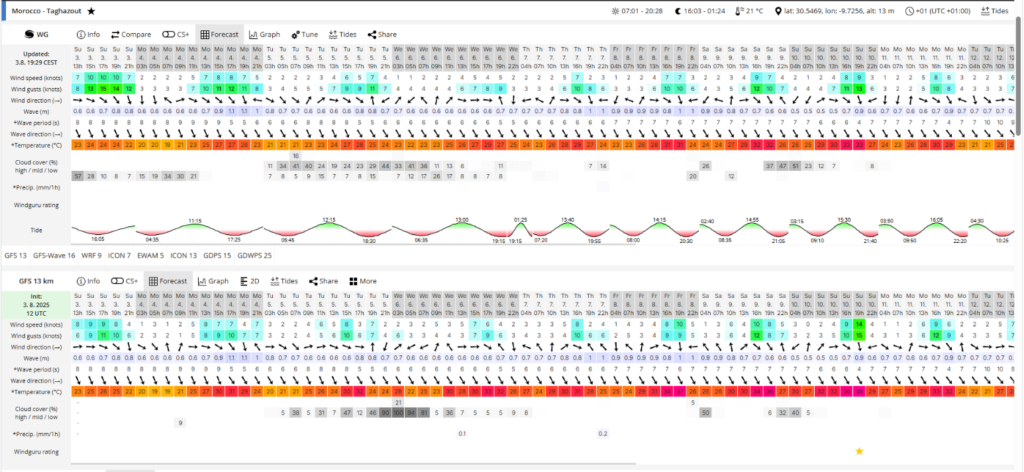
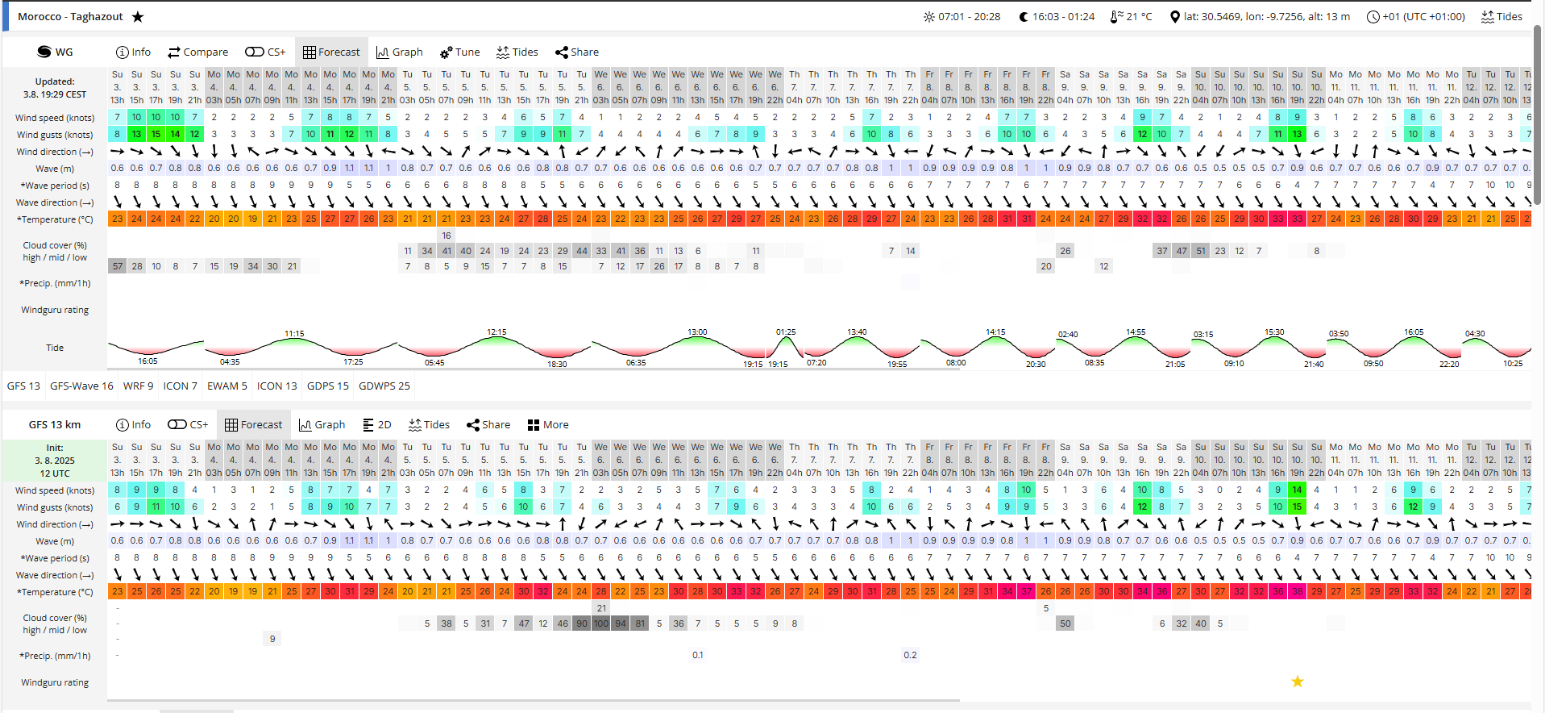
You open a surf forecast for Morocco and see:
0.9 m swell. 13 seconds. NW. Light offshore wind. Mid tide.
If you are new to surfing, that may not tell you very much.
Is 0.9 metres small? Is 13 seconds good? Does offshore wind always mean perfect waves? And why might your surf instructor drive past one beach and take you somewhere else when both are only a few kilometres apart?
The first thing to understand is that a surf forecast is not one number.
Swell height, swell period, swell direction, wind, tide and the shape of each surf spot all work together.
That is why the same forecast can create very different waves at two neighbouring beaches.
To understand surf conditions in Morocco, beginners should look at five things together: swell height, swell period, swell direction, wind and tide. Swell tells you how much wave energy is arriving and from where; period helps indicate how powerful and organised that swell may be; wind affects how clean or messy the waves become; and tide changes how individual surf spots break. Wave height alone is not enough to decide whether conditions are beginner-friendly because different beaches respond differently to the same forecast.
You do not need to become a meteorologist before your first surf lesson.
But understanding these basics will help you understand why the ocean changes every day, and why choosing the right surf spot matters so much.
Morocco Surf Conditions, key things to look at
| Forecast factor | What it tells you | Why beginners should care |
|---|---|---|
| Swell height | Approximate height of the incoming open-ocean swell | More swell can mean larger or stronger waves at exposed spots |
| Swell period | Time between swell waves, measured in seconds | Longer-period swell generally arrives with more power |
| Swell direction | Direction the swell is travelling from | Determines which beaches receive more or less of the swell |
| Wind | Direction and strength of the local wind | Can make waves cleaner, bumpier or harder to surf |
| Tide | How sea level rises and falls during the day | Changes how individual surf spots break |
| Breaking wave size | The waves you actually see at the beach | Depends on all of the above plus the coastline and seabed |
The most important thing to notice is that none of these factors works completely independently.
A number only becomes useful once you understand it in context.
What is the difference between Swell and Wave size?
This is one of the most common sources of confusion for new surfers.
Imagine a forecast showing:
1 metre swell
That does not mean every breaking wave at every beach will be exactly one metre high.
The forecast is describing the incoming swell travelling through the ocean.
What happens when that swell reaches the coast depends on things such as:
- Swell direction
- Swell period
- Coastline orientation
- Headlands
- Reefs
- Sandbanks
- Water depth
- The shape of the seabed
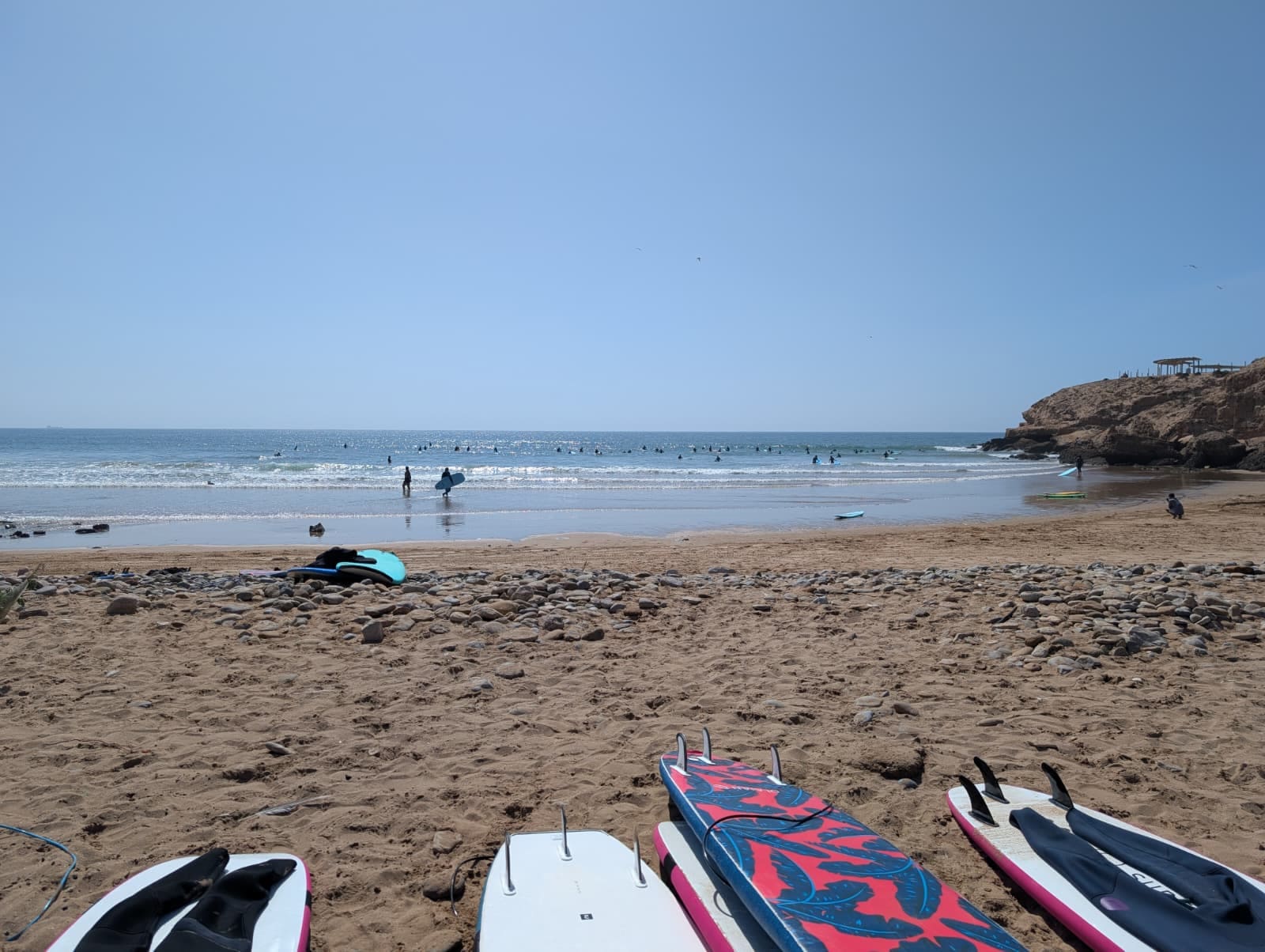
One beach might face directly into the swell and receive much of its energy.
Another beach a few kilometres away may sit behind a headland and receive much less.
So the same offshore swell can produce: larger waves at one spot and smaller, more manageable waves somewhere nearby.
This is one of the main reasons the best beginner surf beach around Tamraght can change from one day to the next.
For a detailed look at those different locations, read our guide to Best Beginner Surf Beaches Near Tamraght: Crocro, Imourane, Banana Beach & More.
1. What does swell height mean?
Swell is wave energy travelling across the ocean, usually generated by weather systems far from the beach.
A swell forecast gives surfers an idea of how much incoming wave energy is approaching the coast.
In simple terms: more swell can mean larger waves.
But that is only a starting point.
A larger swell does not automatically mean:
“better surfing.”
For a complete beginner, too much wave energy can create:
- Stronger whitewater
- More difficult paddling
- Harder positioning
- Stronger currents
- More intimidating conditions
- Fewer useful attempts
Imagine spending an entire session fighting through waves but barely catching anything.
That might look exciting from the beach, but it is not necessarily a productive beginner surf session.
Bigger is not always better
A common beginner mistake is assuming that progression requires increasingly large waves.
It does not.
Progress usually comes from catching lots of appropriate waves.
A smaller day where you catch ten or fifteen manageable waves can give you much more useful practice than a big day where you catch one.
That is why we would never use a universal rule such as:
0.5 m = beginner
1 m = intermediate
2 m = advanced
The actual waves at the beach depend on far more than swell height alone.
2. What is swell Period?
Swell period is one of the most important numbers on a surf forecast, and one of the least intuitive for beginners.
It is measured in seconds and describes the time between waves within the incoming swell.
For example: 0.8 m @ 8 seconds and 0.8 m @ 14 seconds show the same swell height.
But they are not the same surf.
Broadly speaking, a longer-period swell carries more power towards the coast than a shorter-period swell of the same height.
That means a small-looking swell number can sometimes create surprisingly strong surf if the period is long.
A Simple Way to Think About Period
| Period | General idea |
|---|---|
| Shorter period | Waves are generally closer together and the swell tends to arrive with less power |
| Medium period | More organised swell with increasing energy |
| Longer period | More powerful swell with greater energy reaching exposed surf spots |
This is deliberately a conceptual table rather than a rigid scale.
We would not say:
“Anything under X seconds is for beginners.”
or:
“Anything above X seconds is advanced.”
The beach still matters.
0.8 m @ 14 seconds at one surf spot can create very different waves from 0.8 m @ 14 seconds somewhere more sheltered.
So when reading the forecast:
height tells you part of the story.
Period tells you more about the energy behind it.
3. Why does swell Direction matter?
A swell does not hit every part of the coastline equally.
Imagine shining a torch towards an irregular coastline.
Some beaches face directly into the light.
Others sit partly behind a headland.
The same thing happens with ocean swell.
A beach facing into the incoming swell may receive a large amount of its energy.
Another nearby location may be protected from part of that swell.
This is known as exposure.
Why this matters around Tamraght
The coastline around Tamraght and Taghazout has:
- Sandy beaches
- Points
- Headlands
- Bays
- Different orientations
So a single incoming swell can create very different conditions at:
- Crocro
- Imourane / Devil's Rock
- Banana Beach
- Panoramas
- Other nearby spots
One beach might be too powerful for a first-time surfer.
Another might offer much softer whitewater.
Somewhere more protected might barely receive enough swell at all.
That is why saying:
“Crocro is a beginner beach”
is only partly useful.
A better statement is:
Crocro can provide beginner-friendly waves when the conditions suit beginners.
The same applies to every surf spot.
4. Offshore vs Onshore wind: why does wind matter?
Even when the swell is good, wind can completely change what the ocean looks like.
Surf forecasts usually show both:
- Wind direction
- Wind speed
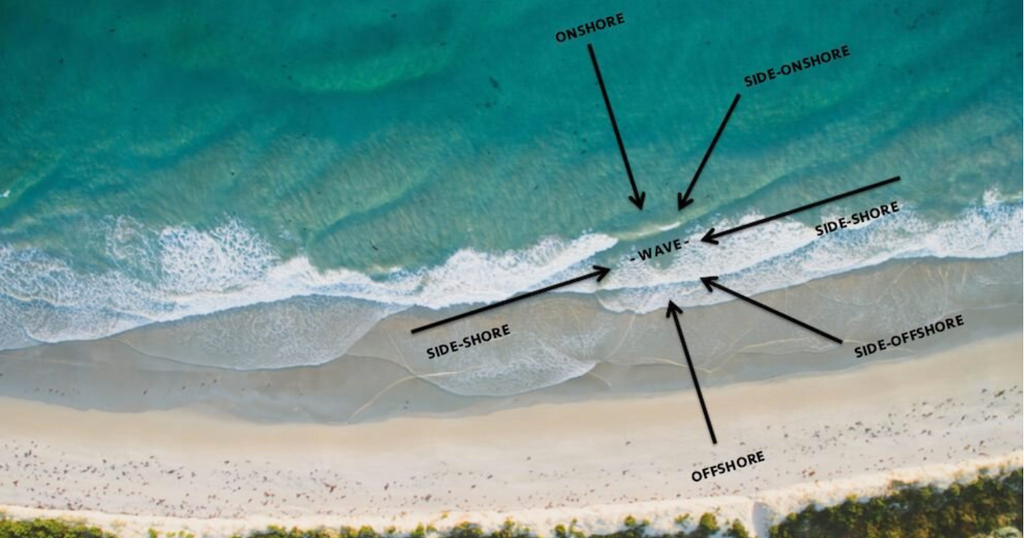
The three terms you will hear most are offshore, onshore and cross-shore.
Offshore Wind
Offshore wind blows:
from the land towards the ocean.
Light offshore wind can help keep the wave face cleaner and more organised.
This is why surfers often get excited when they see light offshore conditions.
But more offshore wind is not automatically better.
Strong offshore wind can also make:
- Paddling into waves harder
- Take-offs more difficult
- Spray blow into your face
- Smaller waves harder to catch
So again, moderation matters.
Onshore Wind
Onshore wind blows:
from the ocean towards the land.
It tends to push against the incoming waves and can make the surface:
- Choppier
- Bumpier
- Less organised
The surf may still be perfectly possible, but the waves can be harder to read and less clean.
For a beginner, messy conditions can make balance and wave selection more difficult.
Cross-Shore Wind
Cross-shore wind blows across the beach rather than directly towards or away from it.
Its effect depends on:
- Wind strength
- Beach orientation
- Wave direction
- The particular surf spot
Offshore Is Not One Compass Direction
This is important.
You may see someone write:
“North-east wind is offshore.”
That statement only makes sense relative to a specific beach.
If two beaches face different directions, the same wind direction can affect them differently.
So:
“Offshore” describes the relationship between the wind and the beach, not one fixed compass direction for all of Morocco.
Is morning always the best time to surf in Morocco?
You will often hear:
“Surf early in the morning.”
There is some logic behind that.
Many days along Morocco's Atlantic coast can begin with lighter or cleaner wind before local wind strengthens later.
But:
morning is not automatically the best surf window every day.
The best time can also depend on:
- Tide
- Swell
- Wind direction
- Weather
- The surf spot
- Your ability
Imagine perfect light wind at 8:00 but a tide that does not suit the beach you want to surf.
Another spot might work better later.
So the more useful rule is:
Morning can often provide cleaner wind, but the best surf window comes from the combination of swell, wind and tide, not the clock alone.
5. How does Tide affect surfing?
Tide is the regular rise and fall of sea level.
During the day, the amount of water covering:
- Sandbanks
- Reefs
- Rocks
changes.
That changes how waves break.
A surf spot may therefore look very different at:
low tide → mid tide → high tide
Does High Tide mean safer surf for beginners?
Not necessarily.
There is no universal rule saying:
high tide = good
or
low tide = bad.
Different surf spots work differently.
At one location, more water may improve the wave.
At another, high tide may make the wave weaker or create awkward shorebreak.
Beach breaks can also change over time because sandbanks move.
So rather than memorising:
“Beginners should always surf mid tide.”
learn this instead:
Tide matters differently at every surf spot.
That is also why local knowledge becomes useful.
An instructor familiar with the area knows not only which beach might work, but when it is likely to work best that day.
6. What does “1-metre waves” actually mean?
This sounds like a simple question.
It isn't always.
Different forecasts can display things such as:
- Swell height
- Breaking-wave estimate
- Significant wave height
- Wave-face estimate
And surfers themselves do not always estimate wave size in exactly the same way.
So if you see:
1 m
on an app, do not automatically conclude:
“I can surf one-metre waves, so these conditions are right for me.”
The breaking waves at your chosen beach may look quite different from the headline forecast number.
For a beginner, this is a more useful way to think:
Instead of:
“I can surf one-metre waves.”
think:
“I feel comfortable in these kinds of conditions at this type of beach.”
That gives you a much better foundation for eventually becoming an independent surfer.
Why two similar Surf Forecasts can produce completely Different Sessions
Let's put the different variables together.
Example A
Imagine:
Smaller swell + longer period + light offshore wind
The swell-height number may look small.
But because the period is longer, the incoming swell may carry plenty of power.
At an exposed surf spot, that could create clean, surprisingly strong sets.
Example B
Now imagine:
Larger swell + shorter period + strong onshore wind
The swell-height number is bigger.
But the waves may be:
- Messy
- Closely spaced
- Difficult to read
- Less organised
For a beginner, Example A is not automatically easier simply because the swell-height number is smaller.
And Example B is not automatically better because the number is larger.
The lesson is:
Wave height alone cannot tell you which surf session will be easier.
Same forecast, Different beach
Now imagine the exact same offshore forecast hitting two beaches.
Beach A: open and exposed to the swell.
Beach B: partly sheltered by the coastline.
Beach A may receive significantly more energy.
Beach B may offer smaller waves.
This is one reason having several nearby surf spots is so valuable.
You are not waiting for one beach to become perfect.
You can look for the beach that best matches the conditions.
What surf conditions are best for Beginners?
There is no single forecast number that defines perfect beginner surf.
Generally, complete beginners benefit from:
- Manageable waves
- Gentle whitewater
- Relatively clean conditions
- Enough space
- Limited strong currents
- Appropriate water depth
- A beach suited to their level
- Plenty of opportunities to catch waves
That final point matters enormously.
Good beginner conditions are conditions that let you practise, not conditions that look impressive from the beach.
A beginner improves through repetition.
You need opportunities to:
- Paddle
- Catch waves
- Pop up
- Fall
- Try again
- Receive feedback
- Repeat
If the ocean is so difficult that you spend the entire lesson surviving, there is much less room for learning.
For the broader beginner experience in Morocco, read our Surfing in Morocco: Complete Guide for Beginners.
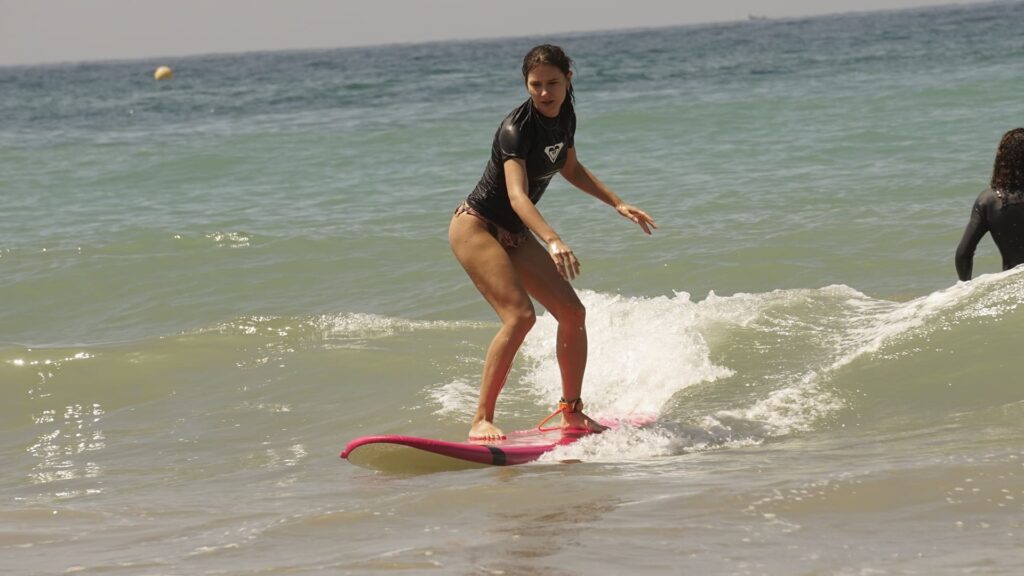
A beginner's 5-step Surf Forecast check
You do not need to analyse ten different charts.
Start with these five things.
Step 1 - Check Swell Height
Ask:
How much incoming swell is forecast?
Do not decide whether it is “good” yet.
Just note the number.
Step 2 - Check Swell Period
Now ask:
How energetic might that swell be?
A smaller longer-period swell may deserve more attention than the height alone suggests.
Step 3 - Check Swell Direction
Ask:
Which beaches are likely to receive the swell most directly?
Which might be more sheltered?
This is where knowledge of the coastline matters.
Step 4 - Check the Wind
Look at:
- Direction
- Strength
- How it changes through the day
Could the morning be cleaner?
Will the wind strengthen later?
Is it offshore relative to the beach you are considering?
Step 5 - Check the Tide
Ask:
How does that particular surf spot normally respond to the tide?
Do not apply a universal rule.
Different beaches behave differently.
And then do One More Thing
Look at the actual ocean.
This might be the most important step of all.
A forecast is a model.
It is an estimate of what the ocean is expected to do.
It is not the ocean itself.
Conditions can:
- Arrive earlier
- Arrive later
- Be stronger
- Be weaker
- Look different from the model
Local observation still matters.
Do beginners need to understand Surf Forecasts before their first lesson?
No.
If you are joining a surf lesson, your instructor should be making the important spot and condition decisions for you.
You do not need to understand swell period before standing on a surfboard for the first time.
But learning these concepts gradually is valuable.
It helps explain:
- Why today's surf session starts at a different time
- Why yesterday's beach is not being used today
- Why the group drives farther to another surf spot
- Why small-looking swell can still create powerful waves
- Why your instructor says conditions are unsuitable
And eventually, understanding conditions becomes part of surfing independently.
Reading surf forecasts is part of becoming an independent surfer, not a prerequisite for taking your first lesson.
If you are preparing for your first session, our First Surf Lesson: What Beginners Should Really Expect guide explains what actually happens during the lesson.
How do Morocco's Surf Conditions change through the year?
Morocco's Atlantic coastline receives changing swell patterns throughout the year.
Broadly:
Autumn
North Atlantic swell becomes more consistent and the surf season starts becoming more active.
Winter
Larger and more frequent Atlantic swells create the powerful conditions Morocco is famous for.
That does not mean beginners cannot surf.
It means spot selection becomes especially important.
Spring
Conditions gradually transition, with a mixture of swell sizes and plenty of opportunities across different levels.
Summer
Surf is generally smaller, which can create very friendly conditions for complete beginners, although individual days still vary.
This is intentionally only a broad overview.
If you want month-by-month detail, read our Best Time of Year to Surf in Morocco guide.
The important point for this article is:
Season gives you a general pattern. The daily forecast tells you what the ocean is actually doing during your trip.
What do these Surf Conditions mean around Tamraght?
This is where all of this theory becomes very practical.
Tamraght sits close to several different surf areas.
Nearby options include:
- Crocro
- Imourane / Devil's Rock
- Banana Beach
- Panoramas
- Other beaches along the coast
These spots do not all face the ocean in exactly the same way.
They do not all have the same:
- Exposure
- Seabed
- Sandbanks
- Shape
- Protection from headlands
So the same incoming swell might create:
too much energy at one beach
useful beginner waves at another
and
almost no surf somewhere more sheltered.
That is one reason Tamraght is such a useful base for a surf trip.
You are not relying on a single beach.
Our full Best Beginner Surf Beaches Near Tamraght guide explains Crocro, Imourane, Banana Beach and the other nearby options in more detail.
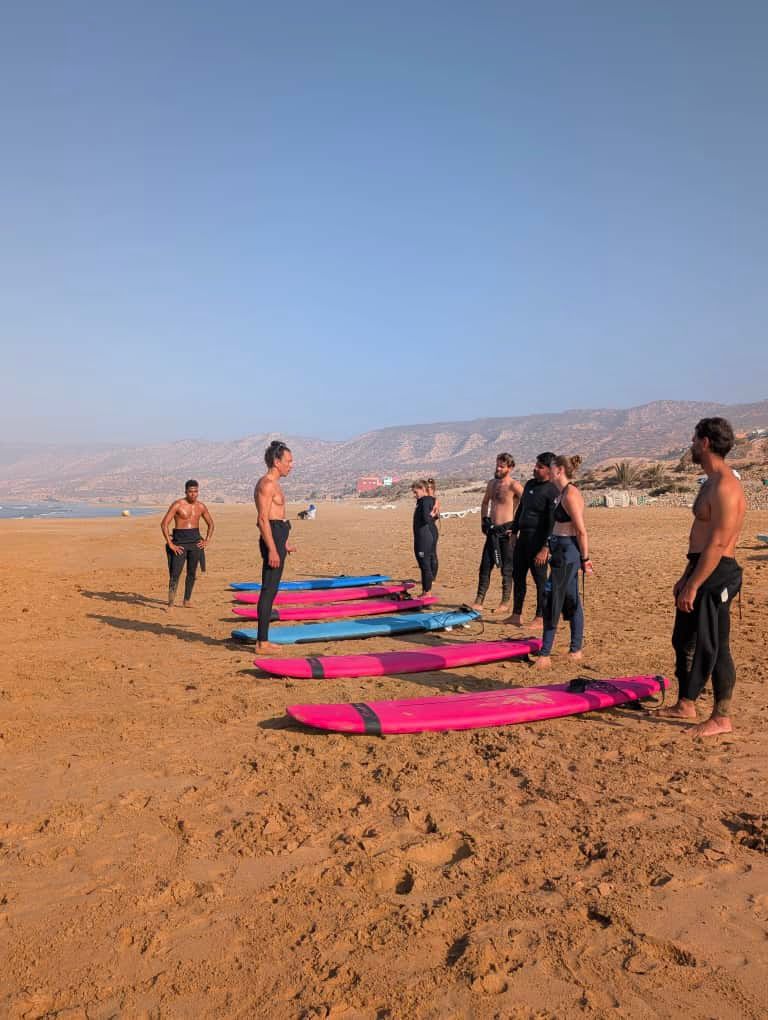
6 common Surf Forecast Mistakes Beginners make
Understanding the basics is useful.
But knowing what not to do can be just as helpful.
1. Looking only at wave height
Seeing:
0.8 m
and deciding:
“Perfect, that's small.”
ignores period, direction, wind and the surf spot itself.
Never judge the session from height alone.
2. Ignoring swell period
A smaller long-period swell can arrive with much more power than a beginner expects.
Always check height and period together.
3. Assuming every nearby beach gets the same waves
It doesn't.
One beach may face the swell.
Another may be protected.
This is why surf schools move between spots.
4. Thinking offshore wind is one fixed compass direction
Offshore means:
from land towards sea at that particular beach.
It is relative to the beach orientation.
5. Believing one tide is best everywhere
There is no:
“Beginners should always surf at high tide.”
The correct tide depends on the surf spot and the conditions.
6. Treating the Forecast as a guarantee
Surf forecasts are extremely useful.
They are still forecasts.
Always compare what the model predicted with what the ocean is actually doing.
How we use Surf Conditions at The Happy Surfers
At The Happy Surfers, we do not choose the day's surf beach simply because it is the closest.
And we definitely do not work with a schedule such as:
“Monday is Crocro. Tuesday is Banana Beach. Wednesday is Imourane.”
The ocean decides more than the calendar does.
Before a surf session, the instructors consider:
- Swell height
- Swell period
- Swell direction
- Wind
- Tide
- Current conditions
- The group's surf level
- What guests are currently working on
Then we choose a spot that makes sense for that combination.
Sometimes that means returning to the same beach several times because it is working well.
Other weeks, the changing conditions mean surfing several different spots.
Why Surf Transport matters
Our seven-night surf packages include:
- 6 coached surf lessons
- 6 additional free-surf opportunities
- Surfboard and wetsuit
- Daily surf transport
- Surf theory
- Surfskate
- Accommodation
- Breakfast and dinner
- Free agadir airport pick up at arrival
The daily transport is not only a convenience.
It is part of the surf strategy.
If the beach closest to the surf house is too large, too windy or simply unsuitable for the group's level, having transport allows us to choose somewhere else.
That flexibility gives beginners a much better chance of surfing appropriate waves rather than simply convenient waves.
You can see the full details on our all-inclusive surf packages in Tamraght.
Frequently Asked Questions about Morocco Surf Conditions
What Are Good Surf Conditions for Beginners?
Good beginner conditions generally mean manageable waves, relatively clean surf, plenty of space and conditions that allow repeated practice.
There is no universal swell-height number that defines beginner conditions because every surf spot responds differently.
What Does Swell Mean in Surfing?
Swell is wave energy travelling across the ocean towards the coast, usually generated by distant weather systems.
When that swell reaches shallow water, the coastline and seabed determine how it becomes breaking surf.
What Is Swell Period?
Swell period is the time between waves in the incoming swell, measured in seconds.
Broadly, a longer-period swell carries more power towards the coastline than a shorter-period swell of the same height.
Is a Longer Swell Period Better for Surfing?
Not automatically.
Longer period can create cleaner, more powerful surf, which experienced surfers may enjoy.
For beginners, that extra power can also make conditions more challenging.
“Better” depends on the surfer and the surf spot.
What Is Offshore Wind?
Offshore wind blows from the land towards the sea.
Light offshore wind often helps keep wave faces cleaner, although very strong offshore wind can still make surfing difficult.
Is Offshore Wind Always Good for Surfing?
No.
Light offshore wind is often favourable, but strong offshore wind can make paddling and catching waves harder.
The complete combination of swell, wind and tide still matters.
Is High Tide or Low Tide Better for Beginner Surfing?
There is no universal answer.
Some surf spots work better with more water, while others work differently at lower or mid tide.
The best tide depends on the specific beach and conditions.
Why Are the Waves Bigger Than the Surf Forecast Says?
The forecast may be showing offshore swell height rather than the exact breaking-wave height at the beach.
Swell period, direction, coastline exposure and seabed shape can all make the breaking waves look different from the headline number.
Is 1-Metre Surf Good for Beginners?
You cannot reliably answer that from the number alone.
One metre of short-period swell at a protected sandy beach may feel completely different from a long-period swell hitting an exposed location.
Always consider period, direction, wind, tide and the specific surf spot.
Do I Need to Understand Surf Forecasts Before Taking Surf Lessons?
No.
Your surf instructor should choose conditions appropriate for your level.
Forecast reading becomes useful as you gain experience and move towards surfing more independently.
What Surf Conditions Does Morocco Get in Winter?
Winter generally brings larger and more consistent North Atlantic swell to Morocco's Atlantic coast.
That creates excellent surf for experienced surfers while making beach and spot selection particularly important for beginners.
For month-by-month detail, read our Best Time of Year to Surf in Morocco guide.
Final Advice: don't judge the surf from one number
When you first look at a surf forecast, it is tempting to search for one simple answer.
Is today's surf good?
But that is not really the right question.
Instead, ask:
What will this swell, period, wind and tide do at the beach I want to surf and does that beach suit my current level?
That is how surfers gradually learn to understand the ocean.
A 0.8-metre forecast does not automatically mean easy waves.
An offshore wind does not automatically mean perfect surf.
High tide is not always best.
And the beach that worked yesterday may not be the best choice tomorrow.
For complete beginners, you do not need to make all of those decisions yourself.
That is part of what good surf coaching provides.
At The Happy Surfers, we use the daily conditions to choose where the group surfs rather than forcing every lesson onto the same beach. Our beginner-friendly weeks include six coached sessions, six additional free-surf opportunities, equipment and daily surf transport, allowing the week's surfing to adapt as the ocean changes.
Ready to understand the forecast from inside the water rather than just from an app? Explore our all-inclusive surf packages in Tamraght and join us for a week of coaching, practice and surfing the conditions that actually suit your level.




0 Comments