


If you are planning to learn to surf, one of the first practical questions is usually: how many surf lessons do I actually need?
Is one lesson enough to see whether you like it? Are three lessons enough to make real progress? Should you book five days of coaching? And at what point can you stop taking lessons and start practising on your own?
There is no magic number.
Surfing is learned through a combination of good coaching, repetition, suitable conditions and time in the water. Two beginners taking exactly the same number of lessons can progress very differently.
But there are useful milestones that can help you decide how many lessons to book.
For most complete beginners, 3 to 5 surf lessons provide a useful introduction, while around five well-structured lessons combined with additional practice can build a much stronger foundation. One lesson is enough to try surfing and learn the basics, but usually not enough to become independent. Becoming comfortable choosing waves, paddling, catching waves and making safe decisions without constant instructor support generally requires considerably more practice.
The important question is therefore not simply “How many surf lessons do I need?”
It is:
How much coaching do I need, and how much practice should I do between those lessons?
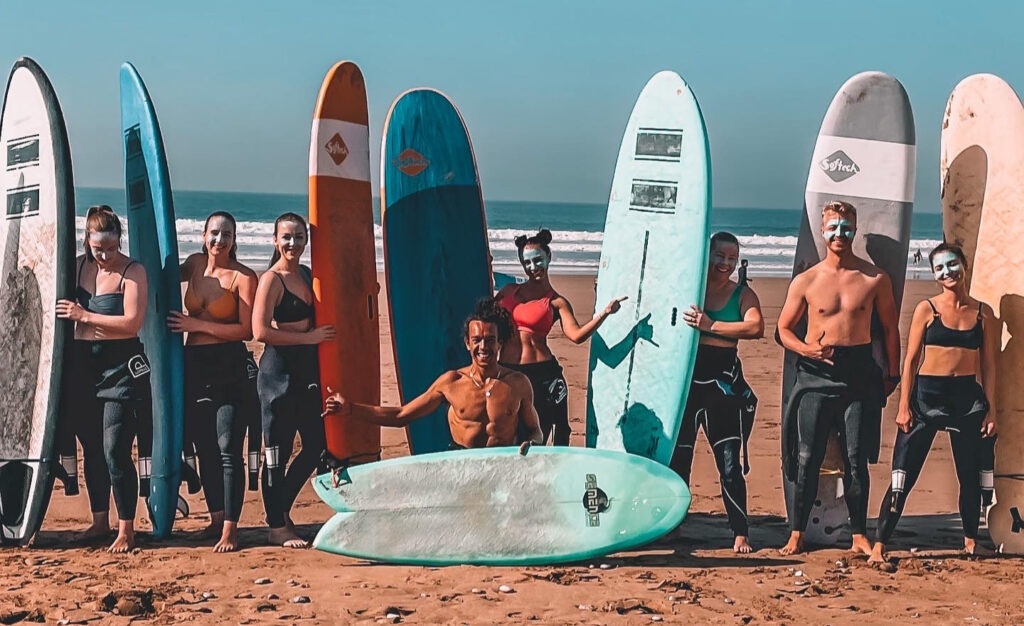
How many surf lessons should a beginner take?
Here is a realistic way to think about beginner surf progression.
| Number of lessons | Realistic goal |
|---|---|
| 1 lesson | Discover surfing, learn basic safety, board positioning and the pop-up, and attempt your first waves with instructor support |
| 2-3 lessons | Reinforce your pop-up, paddling and timing while beginning to need less assistance |
| 4-5 lessons | Build consistency, improve board control and start making more decisions yourself |
| 6-10 lessons | Develop wave selection, positioning, paddling efficiency and more independent surfing skills |
| 10+ lessons + practice | Continue building ocean awareness, consistency, technique and independent decision-making |
These are guidelines, not requirements.
Someone who needs more time is not falling behind. And someone who manages to stand during the first session has not suddenly finished learning to surf.
Surfing is much more than standing on a board.
Is one surf lesson enough?
One surf lesson can be absolutely worthwhile.
If your goal is simply to try surfing for the first time, one lesson may be exactly what you need.
During an introductory lesson, you can normally expect to start learning things such as:
- Basic surf and ocean safety
- How to handle the board
- How to lie correctly on the board
- Basic paddling
- The pop-up
- How to position yourself for beginner waves
- What to do after falling
- How to catch your first waves with instructor support
The goal of that first session is not mastery.
It is to understand the fundamentals and experience what surfing actually feels like.
Some beginners immediately love it. Others discover that surfing is more physically challenging than they expected. Both outcomes make the first lesson worthwhile.
What one lesson usually cannot provide is enough repetition to make everything feel automatic.
You may understand how to pop up on the beach and then discover that doing exactly the same movement on a moving board is completely different.
That is normal.
If you want a detailed picture of that first experience, read our guide to what beginners should really expect from their first surf lesson.
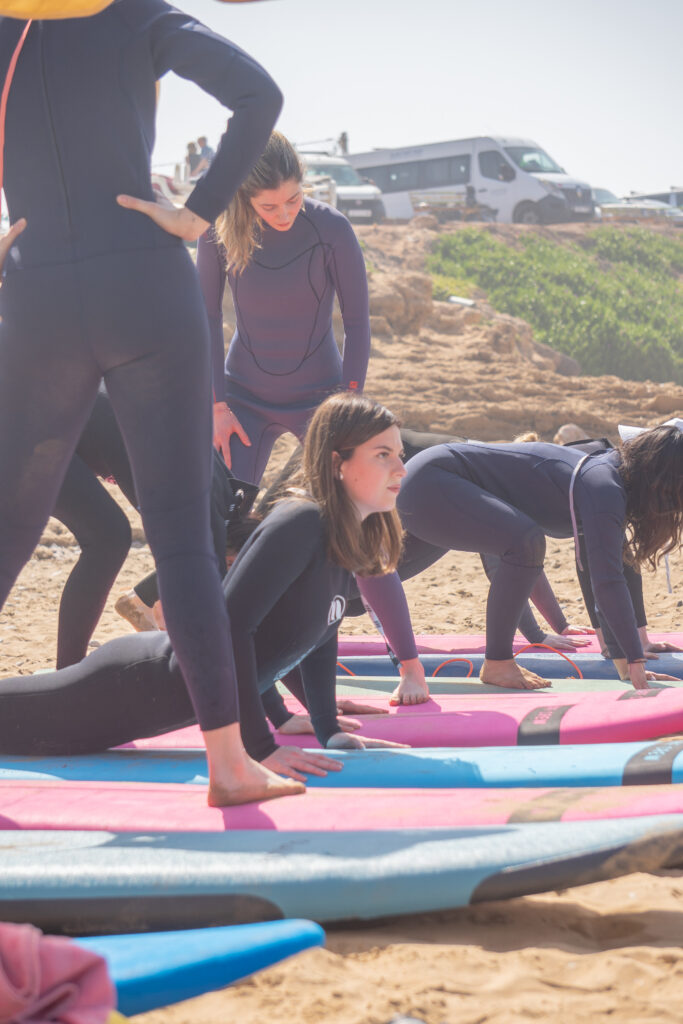
Are 3 surf lessons enough for a beginner?
Three surf lessons can give a beginner a meaningful introduction to surfing. The advantage over taking only one lesson is that your second and third sessions are not simply repetitions of the first.
During lesson one, almost everything is unfamiliar.
By lesson two, you already understand the equipment, the basic movements and what the instructor is asking you to do. That leaves more mental space for improvement.
By lesson three, your instructor may begin seeing recurring patterns in your surfing.
Maybe you:
- Stand too early
- Look down instead of where you want to go
- Put too much weight on the back foot
- Paddle too late
- Position yourself too far forward on the board
- Rush the pop-up
- Lose balance in the same direction repeatedly
This is where coaching becomes especially useful.
Instead of simply telling you what surfing is, the instructor can increasingly help you understand what you personally need to change.
Three lessons can therefore be enough for a short introduction.
But for most complete beginners, it would still be early to assume that they can safely and confidently surf without further coaching or suitable supervision.
Are 5 surf lessons enough?
For many beginners, five well-structured lessons during the same surf trip can create a strong foundation.
Not because five is a magical number. But because it gives you enough sessions for something important to happen:
repetition.
You have time to try something, receive feedback, try again, experience different conditions and gradually recognise your own mistakes.
By lessons four and five, you may be working less on:
“What am I supposed to do?”
and more on:
“How can I do this better?”
Depending on your progression and the conditions, you might be developing:
- A more consistent pop-up
- Better paddling
- Improved balance
- More control over the board
- Better timing
- More confidence catching waves
- A basic understanding of positioning
- Better awareness of what is happening around you
But five lessons should still be viewed as a foundation, not a guarantee of independence.
A beginner who completes five lessons may be progressing very well and still benefit from instructor guidance.
That is completely normal.
Why lessons plus practice work better than lessons alone
This is perhaps the most important point in the entire article.
You do not necessarily need an instructor beside you for every wave you catch.
Coaching and practice serve different purposes. A coach helps you identify what needs to change. Practice gives you enough repetitions to actually change it.
A useful progression can therefore look like:
Coaching → practice → feedback → more practice
rather than:
Lesson → lesson → lesson → lesson without time to experiment
Imagine an instructor tells you that you are looking down every time you stand.
Understanding that takes a few seconds.
Correcting the habit may take dozens of waves.
That is why additional water time between coached sessions can be so valuable when conditions and your level make independent or supervised practice appropriate.
At The Happy Surfers, this principle is built into our weekly structure: our standard seven-night programs combine coached surfing with additional free-surf opportunities, rather than treating every session as another formal lesson. Our current all-inclusive packages include coaching, equipment and daily surf transport.
What changes after 6-10 surf lessons?
Once a beginner has accumulated more lessons and practice, the learning focus can gradually change.
At the beginning, much of your attention goes into simply getting onto the board.
Later, surfing becomes less about:
“Can I stand up?”
and increasingly about:
“Can I put myself in the right place to catch the right wave?”
That is a much bigger challenge.
Depending on your progression, coaching after several sessions may increasingly focus on:
- More efficient paddling
- Better wave selection
- Positioning
- Timing your take-off
- Catching waves with less assistance
- Controlling direction
- Basic trimming
- Surf etiquette
- Understanding where to paddle
- Recognising conditions that suit your level
This is also why lesson count alone is a poor measure of surfing ability.
Someone who can stand on almost every broken wave may still need considerable help reading the ocean.
How many lessons before you can surf alone?
There is no responsible answer such as:
“After six lessons you can surf independently.”
The ocean does not know how many lessons you have taken.
Surfing independently should be judged by your skills and judgement rather than a lesson number.
Standing up is only one part of that.
You are beginning to move towards greater independence when you can:
- Handle your surfboard safely
- Understand basic surf etiquette
- Paddle without assistance
- Catch suitable waves without being pushed
- Control your board reasonably well
- Understand basic positioning
- Recognise conditions appropriate for your level
- Identify obvious hazards
- Know where to enter and exit the water
- Recognise when conditions are too difficult for you
- Get yourself safely back to shore
That final point is particularly important.
Part of becoming a better surfer is learning when not to paddle out.
An instructor does more than teach technique. Good coaching also helps beginners gradually develop the judgement needed to make better decisions around the ocean.
How many lessons until you can catch green waves?
Beginner lessons often start in whitewater: waves that have already broken.
A “green wave” is an unbroken wave that you catch before it breaks.
Moving from whitewater to green waves is an exciting step because it introduces a new set of skills.
Now you need to think much more about:
- Where the wave will break
- Where you should position yourself
- When to start paddling
- Whether the wave is suitable
- When to pop up
- Which direction to surf
So how many lessons does it take?
Again, there is no fixed number.
One beginner might start attempting suitable unbroken waves relatively early with an instructor.
Another may benefit from spending considerably longer developing confidence and consistency in easier conditions.
The transition should depend on your ability and the surf conditions, not because you have reached “lesson five” on a predetermined schedule.
Do you need a surf lesson every time you surf?
No.
In fact, once you have enough understanding to practise appropriately, time without constant instruction can become an important part of learning.
Imagine being told ten different things during every session.
At some point, you need time to focus on just one:
Keep looking forward.
Or:
Paddle earlier.
Or:
Slow down the pop-up.
That focused repetition can be extremely valuable.
A good instructor can then watch you again during the next coached session and identify what improved and what still needs work.
This is why a combination of coaching and appropriate practice can be more useful than simply trying to maximise the number of formal lessons.
Is it better to take surf lessons on consecutive days?
If you are learning during a surf holiday, having several lessons relatively close together can work well.
The movements are still fresh. You remember yesterday's feedback. Your instructor can see what changed from one session to the next. You also spend enough time around the ocean to start recognising patterns.
But that does not mean you need the longest possible surf session every single day.
Beginner surfing can be physically demanding, particularly because paddling uses muscles many people are not accustomed to using repeatedly. Being exhausted can make learning harder.
A good surf week therefore needs some balance between:
- Coaching
- Practice
- Rest
- Food
- Sleep
- Other activities
More hours in the ocean do not automatically equal faster improvement.
How often should a beginner take surf lessons?
That depends heavily on whether you are learning at home or during a surf holiday.
If you live near the ocean
You might take a lesson, practise what you learned for several sessions, then return for another lesson once new questions or difficulties appear.
You do not necessarily need a coach for every session.
If you are on a one-week Surf Trip
Taking several lessons across the week can make more sense.
You have a limited period in which to learn, and concentrated coaching allows instructors to follow your progression from one session to the next.
This is one reason surf camps can work well for beginners: instead of taking one isolated lesson during a holiday, you can combine several days of instruction, practice and feedback.
Private vs Group surf lessons: which is better for beginners?
Private lessons can provide more individual attention, but they are not automatically necessary for every beginner.
Group Lessons
A good group lesson can be very effective for complete beginners.
Advantages include:
- Lower cost per person
- Social experience
- Learning alongside people at a similar stage
- Opportunity to watch common mistakes and corrections
The key is that the group should be appropriate for the instructor to coach safely and meaningfully.
Private Lessons
Private coaching gives the instructor much more time to focus on one surfer.
It can be particularly useful if:
- You have a specific technical issue
- You want more individual feedback
- You feel particularly nervous in the ocean
- Your ability is very different from others in the group
- You have limited time available to learn
- You have already learned the basics and want targeted corrections
For a complete beginner, however, a well-run group lesson can provide everything needed to start.
Why do some beginners need more lessons than others?
Comparing your progression with someone else's is rarely useful.
Several factors influence how quickly surfing begins to feel comfortable.
1. Your confidence in the ocean
Someone who has spent years swimming in waves may initially feel more comfortable than someone who has rarely been in the sea.
That does not determine who will eventually become the better surfer.
It simply changes the starting point.
2. Surf conditions
The ocean can make the exact same surfer look very different from one day to the next.
A session in manageable, beginner-appropriate conditions may feel completely different from one in stronger or more disorganised waves.
That is why choosing the right beach and conditions matters so much for beginner progression.
If you are planning a surf trip to Morocco, our guide to beginner surfing in Tamraght explains why access to several different surf spots can be useful for learners.
3. How consistently you surf
Three lessons over three consecutive weeks are not the same learning experience as three lessons spread across several years.
Skills become easier to reinforce when you practise regularly enough to remember previous feedback.
4. Practice between lessons
Listening to your instructor helps.
Repeating the movement afterwards is what gives you the opportunity to turn that feedback into a habit.
5. Physical condition
General fitness, mobility and coordination can influence the early learning process, but you do not need to arrive looking like a professional athlete.
Surfing itself gradually develops surf-specific fitness.
6. Coaching quality
Good coaching should involve more than sending beginners into waves.
An instructor should observe you, identify useful corrections and adapt the session to your ability and the conditions.
What if you don't stand up during your first lesson?
Nothing has gone wrong.
Surfing combines several unfamiliar skills at once:
- Paddling
- Positioning
- Balance
- Timing
- Reading moving water
- Executing the pop-up
- Processing instructions
Some people stand quickly.
Others need more repetition.
And even if you do stand immediately, that does not necessarily mean you learned more than the person beside you who did not.
Your first goal should be understanding and control, not proving that you can stand as quickly as possible.
If this is something you are worried about, our first surf lesson guide goes into the first-session experience in more detail.
How many lessons does it take to actually learn surfing?
This is slightly different from asking how many lessons you should book.
You can learn the fundamentals relatively quickly.
Becoming a genuinely independent surfer takes considerably longer because surfing is an open skill: the environment changes every time you enter the water.
Different days bring different:
- Waves
- Tides
- Winds
- Currents
- Crowds
- Surf spots
That long-term progression is exactly why we keep the broader question separate from this article.
For the full timeline from first sessions through months of regular practice, read How Long Does It Take to Learn Surfing? A Realistic Beginner Timeline.
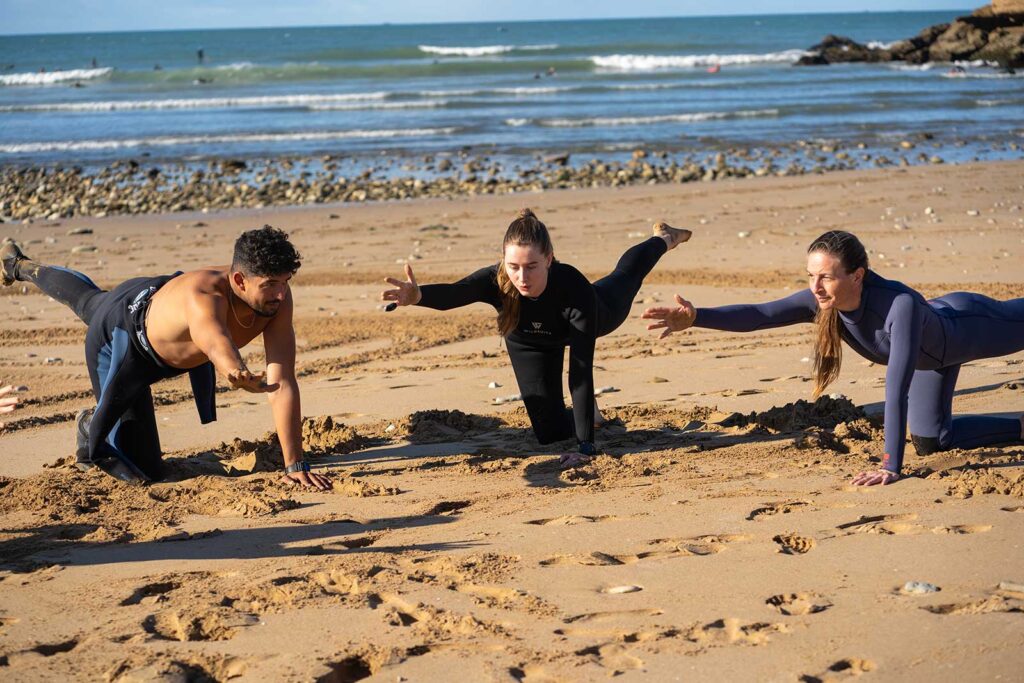
How we structure a beginner surf week at The Happy Surfers
At The Happy Surfers, we do not expect six lessons to turn a complete beginner into an independent surfer.
That is not how learning to surf works.
Instead, our standard seven-night surf programs are designed around a combination of coaching and additional practice.
A typical week includes:
- 6 coached surf lessons
- 6 additional free-surf opportunities
- Surfboard and wetsuit
- Daily transport to the selected surf spot
- Surfskate
- Accommodation
- Pick up at Agadir airport on arrival
- Breakfast and dinner
Guests choosing our Surf & Yoga package also have 6 yoga classes during the week.
Our current package structure combines daily coaching, equipment and surf transport, with the surf spot chosen according to the group and conditions rather than forcing every session onto the same beach.
Why 6 lessons + practice?
The aim is not simply to maximise the number of hours you spend with an instructor.
It is to create a useful cycle:
Learn something → practise it → receive feedback → practise again.
During the coached session, your instructor can identify what you should work on.
During the additional surf time, you have the opportunity to repeat it.
During the next lesson, the instructor can see what changed.
For a complete beginner, six coached sessions across a week can therefore provide a strong starting structure without pretending that learning ends on day six.
And because surf conditions change, our instructors can also adapt the surf spot and session to the group's level rather than expecting every beach to work equally well every day.
If you want to see what is included, explore our all-inclusive surf packages in Tamraght.
Frequently Asked Questions
How many surf lessons should a beginner take?
For many complete beginners, 3-5 lessons can provide a useful introduction, especially when those lessons are combined with additional practice. Becoming independent generally takes much more time in the water than simply completing a fixed number of lessons.
Is one surf lesson enough?
One lesson is enough to try surfing, learn basic safety and experience your first waves. It is generally not enough to become an independent surfer.
Are 5 surf lessons enough?
Five well-structured lessons can build a strong beginner foundation, particularly when combined with additional practice. They should not be treated as a guarantee that you will be ready to surf independently.
Can I learn to surf in one week?
You can learn a lot in one week and may make significant progress, but “learning to surf” is much broader than learning to stand on a board. Becoming independent requires wave-reading, positioning, ocean awareness and experience in different conditions.
For the broader progression timeline, read our guide to how long it takes to learn surfing.
How many lessons before I can surf alone?
There is no fixed number. You should base independence on your ability to manage your board, understand basic surf etiquette, catch suitable waves, recognise hazards and judge whether conditions are appropriate for your level.
Should I take surf lessons on consecutive days?
Several lessons relatively close together can be useful because previous feedback remains fresh and instructors can follow your progression. However, rest and recovery still matter, particularly for complete beginners.
Are private surf lessons better for beginners?
Not necessarily. A well-run group lesson can be an excellent way to learn the fundamentals. Private coaching becomes particularly useful when you want more individual feedback, have a specific difficulty or want to focus intensively on your own progression.
Final Advice: don't count lessons, build a learning rhythm
So, how many surf lessons does a beginner really need?
If you only want to experience surfing once, one lesson can be enough to start.
If you want a proper introduction, three lessons give you time to repeat and improve.
If you want to build a stronger foundation during a surf trip, around five coached sessions combined with additional practice can be a very useful structure.
After that, the question becomes less about counting lessons and more about developing the skills needed to make your own decisions in the ocean.
There is no finish line at lesson five or lesson ten.
Surfing develops through a cycle of:
coaching, practice, mistakes, corrections and more time in the water.
That is also what makes learning it so rewarding.
At The Happy Surfers, our beginner-friendly surf weeks combine six coached lessons with six additional free-surf opportunities, equipment and daily transport to the surf spot selected for your level and the conditions.
Ready to start? Explore our all-inclusive surf packages in Tamraght and choose the stay that matches the way you want to learn.





0 Comments