

Learning to surf involves a lot of falling.
You miss waves. The nose of the board dives underwater. You finally stand up and immediately lose your balance. Your instructor tells you to look forward, and somehow you find yourself staring at your feet again on the very next wave.
All of this is normal.
The challenge is not avoiding every mistake. It is learning to recognise which mistake is stopping you first and focusing on that before worrying about everything else.
Beginners often try to correct their paddling, pop-up, foot position, balance and wave selection all at the same time. In reality, surfing usually improves faster when you identify one useful correction, practise it repeatedly and then move on to the next.
The most common beginner surfing mistakes include using a board or surfing conditions that are too difficult, lying in the wrong position on the board, inefficient paddling, mistiming the take-off, going to your knees during the pop-up, looking down, standing too upright and trying to improve too many things at once. Most of these mistakes improve through one clear correction at a time, plenty of repetition and surfing in conditions appropriate for your level.
Here are ten of the mistakes we see most often when people start surfing, and what to work on instead.
Beginner Surfing Mistakes at a Glance
| Mistake | What usually happens | Main thing to work on |
|---|---|---|
| Using the wrong surfboard | Paddling feels difficult and the board is unstable | Use a stable, beginner-appropriate board |
| Surfing conditions above your level | You spend more time struggling than catching waves | Choose manageable conditions |
| Ignoring ocean awareness and etiquette | You focus only on standing and miss what is happening around you | Learn safety and awareness alongside technique |
| Lying in the wrong position | The nose dives or the board feels slow | Find the correct position for your board |
| Inefficient paddling | Waves pass underneath you | Improve timing and use controlled strokes |
| Mistiming the take-off | You stand too early or too late | Learn to feel when the wave starts carrying the board |
| Going to your knees | The pop-up becomes slow and unstable | Move from prone to your surf stance in one movement |
| Looking down | Balance and direction suffer | Look where you want to go |
| Standing too upright and stiff | The board feels unstable and difficult to control | Bend your knees and stay relaxed |
| Trying to fix everything at once | Progress feels confusing and inconsistent | Focus on one correction at a time |
Mistake #1: Choosing a surfboard that is too difficult
One of the easiest ways to make learning harder is choosing a surfboard because it looks like the boards experienced surfers use.
Smaller performance boards can look appealing, but beginners usually benefit from something very different.
A larger, more stable board generally makes it easier to:
- Paddle
- Catch waves
- Balance
- Practise the pop-up
- Get more repetitions during a session
That last point matters.
If you spend most of your session struggling to paddle into waves, you get very few opportunities to practise the actual skills you are trying to improve.
How to Fix It
Choose a board appropriate for your size, level and the conditions rather than trying to move to a smaller board as quickly as possible.
There is no prize for riding the smallest board on the beach.
A beginner-friendly board that lets you catch more waves can help you practise far more effectively than a difficult board that looks more advanced.
If you are taking lessons, let your instructor help choose the equipment.
Your board should help you learn, not become another obstacle you need to overcome.

Mistake #2: Surfing conditions that are too difficult
Beginners sometimes assume that bigger or more powerful waves will help them progress faster.
Often, the opposite happens.
If the conditions are beyond your current ability, you may spend the entire session:
- Fighting through waves
- Getting pushed around
- Struggling to paddle
- Feeling nervous
- Catching very few waves
- Becoming exhausted quickly
That gives you fewer useful repetitions.
How to Fix It
Surf conditions appropriate for your current level.
And remember:
The best beach for a beginner today may not be the best beach tomorrow.
Swell, wind, tide and wave size all change.
A spot that was gentle yesterday might be considerably more challenging today.
This is one reason surf schools and surf camps often choose the surf spot each day rather than always using the closest beach.
Around Tamraght, having access to several different surf areas makes it possible to adapt the session to the conditions and the group's ability.
If you are considering Morocco for your first surf trip, read our guide to whether Tamraght is good for beginner surfers.
Mistake #3: Focusing on standing up and ignoring everything around you
It is understandable.
When you are learning to surf, standing on the board feels like the big objective.
But surfing is not only a balance exercise.
The ocean is constantly changing, and other surfers are moving around you.
A beginner also needs to start becoming aware of:
- Where waves are breaking
- Where other surfers are positioned
- Where you are drifting
- Where to enter and exit the water
- Basic surf priority and etiquette
- Conditions that may be inappropriate for your level
Someone can have an excellent pop-up and still make poor decisions in the water.
How to Fix It
Treat ocean awareness as part of learning to surf, not as something you will worry about after mastering the technique.
Listen carefully during safety briefings.
Ask your instructor questions when you do not understand why the group is entering the water at a particular place or avoiding another area.
Start observing the ocean before you paddle out.
The goal is gradually to understand not only how to surf a wave, but how to behave safely in the environment where surfing happens.
Mistake #4: Lying in the wrong position on the surfboard
Your position while paddling has a surprisingly large effect on what happens next.
Lie too far forward and the nose may dig into the water.
Lie too far back and the front of the board can lift excessively, creating more drag and making it harder to catch the wave.
Beginners sometimes try to solve this by constantly moving around on the board without really understanding what they are looking for.
How to Fix It
Find the neutral position for the specific board you are using.
Different boards have different shapes and sizes, so there is no universal measurement that works for everyone.
Your instructor can help you identify the correct position.
Once you find it, pay attention to how it feels.
The board should paddle efficiently without the nose digging excessively into the water or sitting too high above it.
This may sound like a small detail, but poor board positioning can make paddling, wave catching and take-offs considerably harder.
Mistake #5: Paddling inefficiently, or stopping too soon
A lot happens before the pop-up.
If you do not generate enough speed to catch the wave, the best pop-up in the world will not help.
Common beginner paddling mistakes include:
- Starting too late
- Using short, rushed strokes
- Paddling without enough commitment
- Losing the correct position on the board
- Looking around too much
- Stopping as soon as the wave reaches the board
Sometimes the beginner feels the wave approaching and immediately tries to stand.
But the wave has not actually started carrying the board yet.
The result?
The wave passes underneath.
How to Fix It
Focus on controlled, purposeful strokes and keep paddling until the board has genuinely accelerated with the wave.
Good paddling is partly physical, but it is also about timing and positioning.
You do not simply need to paddle harder.
You need to paddle at the right moment, from the right position and long enough for the wave to take you.
This is one of those skills where instructor feedback is extremely useful because the difference between “almost caught it” and “caught it” can be difficult to understand from the board.
Mistake #6: Popping up too early or too late
The pop-up gets a lot of attention in beginner surfing.
But the movement itself is only half the problem.
The other half is when you do it.
Popping up too early
You try to stand before the wave has properly taken the board.
The board slows down or the wave passes underneath you.
Popping up too late
You wait until the take-off becomes rushed, unstable or steeper than necessary.
You may feel as if you are constantly reacting rather than moving smoothly.
How to Fix It
Learn to recognise the moment when the board begins accelerating with the wave.
That feeling becomes easier to recognise through repetition.
This is also why simply practising pop-ups on land is not enough.
Land practice helps with the movement.
Time in the ocean teaches you when to use it.
If you are preparing for your first session, our guide to what beginners should expect during their first surf lesson explains the early learning process in more detail.
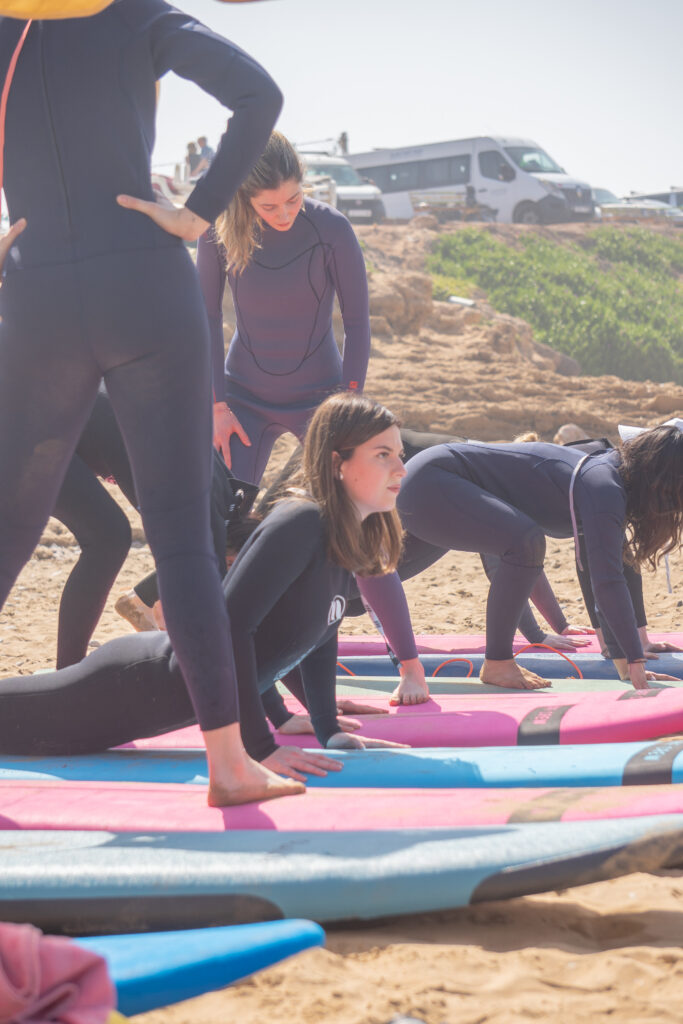
Mistake #7: Going to your knees during the pop-up
This is one of the most recognisable beginner surfing habits.
Instead of moving from:
lying down → surf stance
the surfer moves:
lying down → knees → feet
It feels safer because the knees create an intermediate position.
Unfortunately, that intermediate step often makes the take-off slower and less stable.
By the time you are trying to move from your knees onto your feet, the board and wave have already changed underneath you.
How to Fix It
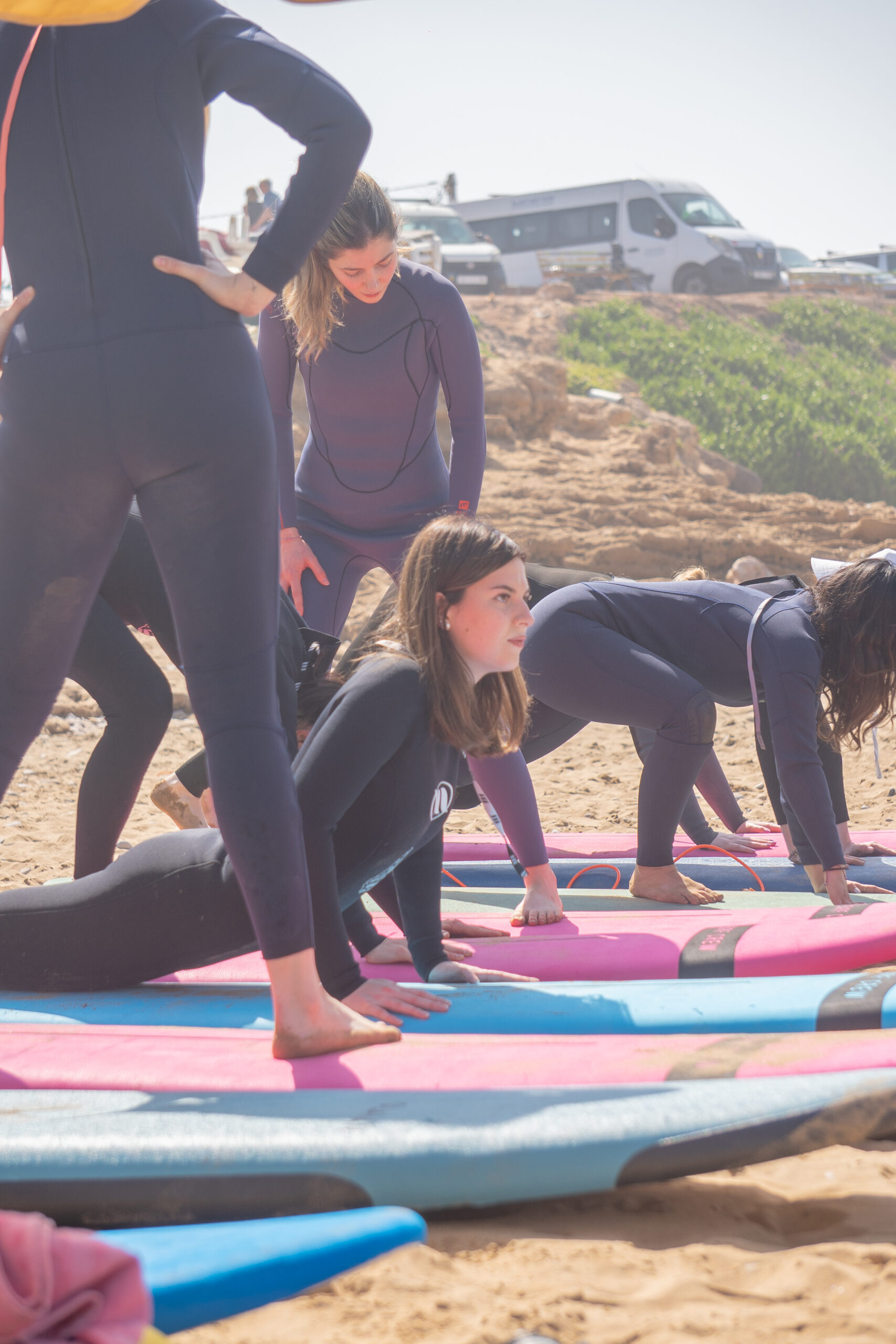
Practise moving from your prone position directly into a stable surf stance.
You do not need to make the movement aggressive or rushed.
The goal is a controlled, continuous transition rather than stopping on your knees.
Land practice can help because it allows you to repeat the movement without also worrying about waves, paddling and balance.
But do not become obsessed with making the movement look perfect on the beach.
Eventually, it needs to work on a moving surfboard.
Mistake #8: Looking down at your feet
You finally stand.
Then you immediately look down to check whether your feet are in the right position.
It feels logical.
Unfortunately, it also takes your attention away from where you are travelling.
Beginners who stare at the board often become more tense and less aware of the wave in front of them.
How to Fix It
Look ahead in the direction you want to travel.
Your feet matter, but you do not need to watch them continuously.
Once you have stood, try to shift your attention away from:
“Where exactly are my feet?”
and towards:
“Where am I going?”
Your instructor can help correct your foot placement afterwards if necessary.
During the ride, looking ahead usually gives you much more useful information than looking at the deck of your board.
Mistake #9: Standing too upright and stiff
Standing up is exciting.
So exciting that many beginners pop up and immediately freeze.
Their legs straighten.
Their shoulders become tense.
Their arms stiffen.
And suddenly the surfboard feels impossible to balance on.
A rigid body has much less ability to absorb the movement underneath it.
How to Fix It
Aim for a relaxed, balanced stance.
Think about:
- Soft, flexed knees
- Relaxed shoulders
- Eyes ahead
- Stable foot position
- A posture that allows you to react
You do not need an exaggerated squat.
And wildly moving your arms does not necessarily create better balance.
The goal is simply to avoid becoming completely rigid the moment you stand.
The board is moving.
The water is moving.
Your body needs enough freedom to respond.
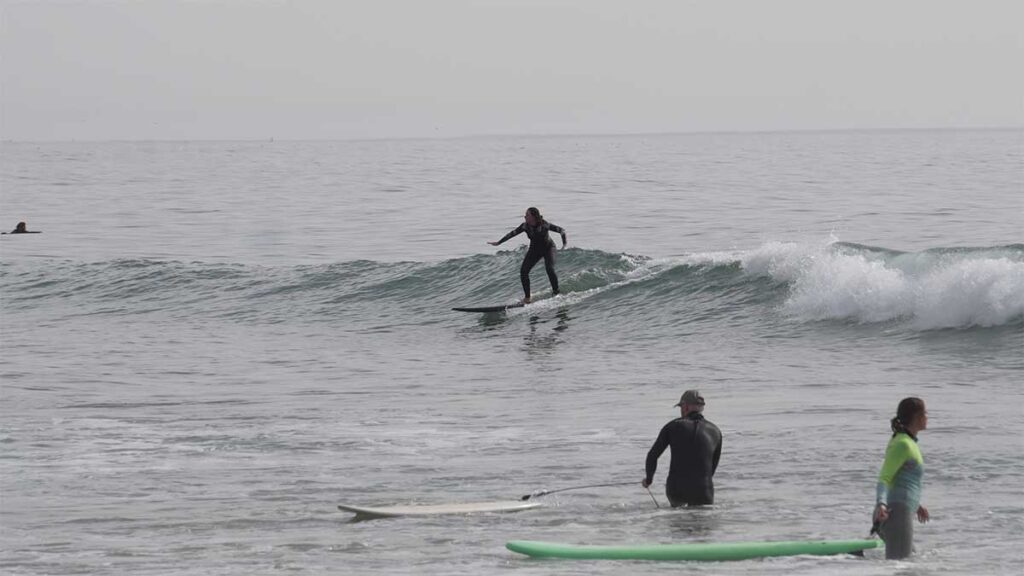
Mistake #10: Trying to correct everything at once
This may be the most important mistake on the list.
A beginner can receive an overwhelming amount of information during one surf session:
Paddle earlier.
Look forward.
Bend your knees.
Don't go to your knees.
Move slightly forward.
Keep paddling.
Wait longer.
Relax.
All of that advice may be correct.
But trying to consciously remember eight corrections on your next wave is rarely helpful.
How to Fix It
Choose one useful priority.
For example:
“For the next few waves, I am only going to focus on looking forward.”
Or:
“I am going to keep paddling longer before standing.”
Or:
“I am going to stop putting my knees down.”
Work on that correction for several attempts.
Once it becomes more natural, move to the next important issue.
This is one of the biggest benefits of good coaching.
An instructor can help decide which mistake matters most right now, rather than simply giving you an endless list of things to improve.
How do you know which surfing mistake you are making?
Sometimes you know exactly what went wrong.
Other times you simply fall.
The result alone does not always identify the cause, but certain patterns can give you an idea of what to discuss with your instructor.
| What happens | Possible things to check |
|---|---|
| The wave passes underneath you | Positioning, paddling speed or take-off timing |
| The nose of the board dives underwater | Position on the board, wave choice or take-off timing |
| The board turns sideways before you stand | Alignment, paddling or positioning |
| You catch the wave but cannot stand | Pop-up technique, timing or fatigue |
| You stand but immediately lose balance | Gaze, stance, tension or foot placement |
| You catch almost no waves | Conditions, positioning, paddling or wave selection |
| You keep ending up on your knees | Pop-up movement and commitment |
| You feel completely exhausted very quickly | Paddling efficiency, conditions, fitness or too much time fighting waves |
A single result can have several causes.
For example, a nose dive does not automatically mean you are lying too far forward. The wave, timing and board position can all contribute.
Use the table as a starting point, not as a substitute for someone actually watching your surfing.
Which beginner surfing mistakes are normal during your first lesson?
Almost all of them.
Your first surf session introduces a huge number of unfamiliar things at once.
You may:
- Miss waves
- Fall immediately after standing
- Paddle at the wrong time
- Look at your feet
- Nose dive
- Forget what your instructor told you 30 seconds earlier
- Go to your knees
- Stand with your feet in strange positions
- Feel completely exhausted after paddling
None of those automatically means you are bad at surfing.
They mean you are learning.
The purpose of your first lesson is not to eliminate every mistake.
It is to start understanding the process.
If you want to know what that first session normally involves, read First Surf Lesson: What Beginners Should Really Expect.
What should a beginner surfer focus on first?
Beginners sometimes want to learn turns before they are consistently catching waves.
It is understandable.
Turning looks like surfing.
Paddling and positioning do not look nearly as exciting.
But there is a useful progression.
1. Safety and ocean awareness
Before anything else, learn how to behave safely with the board, waves and other surfers around you.
2. Catching waves
The more suitable waves you catch, the more opportunities you have to practise everything that comes afterwards.
3. A reliable take-off
Work towards a controlled movement from paddling to your surf stance.
4. Stable stance
Once standing, learn to remain relaxed and balanced rather than simply surviving for a second.
5. Board control
Begin understanding how your weight, gaze and body position influence where the board travels.
6. Wave selection and greater independence
As your technique improves, your ability to read the ocean becomes increasingly important.
You do not need to rush through these stages.
Building strong fundamentals generally creates a better base for everything that comes afterwards.
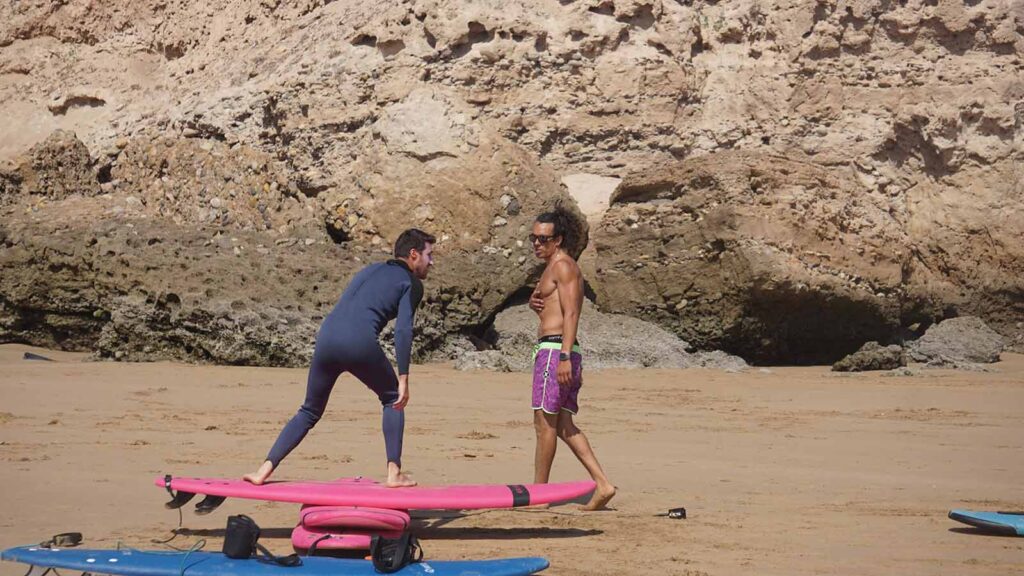
Do surf lessons help correct beginner mistakes?
Yes, particularly when you keep repeating a mistake without realising it.
One of the hardest parts of learning to surf is that you cannot easily see yourself.
Something may feel completely correct from your perspective while looking very different to an instructor standing nearby.
A coach may notice immediately that:
- You always stop paddling too early
- Your hands are consistently in the wrong place during the pop-up
- You look down every time you stand
- You position yourself incorrectly before waves arrive
- You are choosing waves that do not suit your current ability
That feedback can save a lot of trial and error.
But you do not necessarily need a formal lesson for every surf session.
A useful learning rhythm is often:
Coaching → practice → feedback → more practice
The instructor helps identify what to change.
Practice gives you enough repetitions to work on it.
The next coached session shows whether the correction is starting to work.
If you are deciding how much coaching to book, read our guide to how many surf lessons a beginner really needs.
How long does it take to stop making beginner surfing mistakes?
Some mistakes disappear quickly.
Others return whenever:
- The waves become bigger
- You are tired
- You change surfboards
- You surf a new spot
- You start learning a more difficult skill
That is normal.
Surfing progression is not a straight line.
You might have an excellent session one day and struggle with something you thought you had solved the next.
The goal is not to reach a point where you never make mistakes.
Experienced surfers make mistakes too.
What changes is your ability to:
- Recognise them
- Understand why they happened
- Correct them
- Make better decisions in different conditions
If you are more interested in the overall progression timeline, read our complete guide to how long it takes to learn surfing.
How we help beginners correct surfing mistakes at The Happy Surfers
At The Happy Surfers, we do not expect complete beginners to correct ten different things at once.
Our goal is to help you build your surfing step by step.
Our standard seven-night surf programs include:
- 6 coached surf lessons
- 6 additional free-surf opportunities
- Surfboard and wetsuit
- Daily transport to the selected surf spot
- Surfskate
- Surf theory where relevant
- Accommodation
- Breakfast and dinner
- Agadir airport pick up at arrival
Guests booking our Surf & Yoga package also have 6 yoga classes during the week.
The combination of coached sessions and additional practice is deliberate.
During a lesson, your instructor might notice one important issue:
You are looking down every time you stand.
During the additional surf time, you can focus on that correction.
At the next lesson, the instructor can see whether it has improved and decide what to work on next.
We also do not force every beginner session onto the same beach.
Conditions around Tamraght change with the swell, wind and tide, so the surf spot is selected according to the day's conditions and the group's level.
For beginners, the goal is not to find the biggest waves.
It is to find conditions that give you a good opportunity to learn, practise and catch waves.
If you want to start surfing in Morocco, explore our all-inclusive surf packages in Tamraght and see what is included during the week.
Frequently Asked Questions about Beginner Surfing Mistakes
What is the most common beginner surfing mistake?
There is no single mistake every beginner makes, but poor paddling, looking down, mistiming the take-off and trying to stand through the knees are extremely common. Choosing conditions that are too difficult can also make all of these technical problems harder to correct.
Why do I keep missing waves when surfing?
The most common things to check are your positioning, paddling speed and timing. You may be starting to paddle too late, stopping too early or positioning yourself where the wave is not yet ready to carry the board.
Why does the nose of my surfboard keep diving?
A nose dive can happen for several reasons, including lying too far forward, taking off too late or choosing a wave that is too steep for your current technique. Ask an instructor to watch the whole sequence rather than assuming board position is always the problem.
Why do I keep going to my knees when I surf?
Going to the knees often feels safer because it creates an intermediate stage between lying down and standing. Unfortunately, it usually makes the take-off slower. Practise moving from your prone position directly into your surf stance in one controlled movement.
Why do I fall immediately after standing up?
Check whether you are looking down, standing too upright, becoming tense or placing your feet poorly. Falling immediately can also result from take-off timing or the board already being unstable before you stand.
Should beginner surfers look at their feet?
Try not to stare at your feet while riding. Looking ahead gives you more useful information about where you are travelling and tends to support a more natural stance and better awareness.
What should a beginner surfer work on first?
Prioritise safety and ocean awareness, then catching waves consistently, your take-off, a stable stance and basic board control. More advanced manoeuvres become much easier once those fundamentals are stronger.
How can I improve my surfing faster as a beginner?
Focus on productive practice rather than simply spending as many hours as possible in the water. Surf appropriate conditions, use suitable equipment, get useful feedback and concentrate on one important correction at a time.
Do surf lessons help correct bad habits?
Yes. An instructor can often identify recurring mistakes that are difficult to feel from the board yourself. Lessons become particularly useful when you keep experiencing the same problem but cannot identify the cause.
How many surf lessons does a beginner need?
There is no fixed number, but several coached sessions combined with additional practice generally provide a stronger foundation than one isolated lesson. Read our full guide to how many surf lessons beginners need for a detailed progression from one lesson through ten and beyond.
How long does it take to stop feeling like a beginner surfer?
There is no universal timeline because progression depends on frequency, conditions, coaching, ocean confidence and practice. Our realistic guide to how long it takes to learn surfing covers the broader learning timeline.
Final advice: Fix one thing at a time
Surfing is full of mistakes.
That does not change completely when you stop being a beginner.
What changes is your ability to understand what went wrong.
If you missed the wave because you stopped paddling too early, work on paddling.
If you stood up but stared at your feet, work on looking forward.
If you keep going to your knees, focus on the pop-up.
If you barely catch any waves because the conditions are too difficult, find somewhere more appropriate for your level.
You do not need to fix your entire surfing technique on the next wave.
Find the earliest important mistake, correct one thing and give yourself enough repetitions to practise it.
Then move on.
That cycle,
mistake → feedback → correction → practice
is how surfing gradually becomes less confusing and more intuitive.
At The Happy Surfers, our beginner-friendly weeks combine six coached surf lessons with six additional free-surf opportunities, equipment and daily transport to the surf spot selected for the conditions and your level.
Ready to start learning? Explore our all-inclusive surf packages in Tamraght and join us for a week of coaching, practice and plenty of time in the ocean.





0 Comments